
Product Ideation: Haven Mental Health App MVP
Defining a Differentiated Mental Wellness Product
Client
Mental Health Support Application (Greenfield Ideation)
Background
This case study focuses on the initial product ideation, research, and validation phase for Haven, a mental health support application. The project was launched with a no-code MVP entirely designed and executed by me to test market hypotheses before committing to full development.
Problem Statement
High churn and lack of context-specific support in existing mental health apps. How do we redefine support to be responsive to the user's Mood, Context, and Preferred Content Type?
The Core Problem: Lack of Retention and Context
The mental wellness market is crowded, but saturated with generic, one-size-fits-all tools (primarily focused on meditation). I identified a critical gap: retention issues stem from a lack of personalization and contextual relevance.
- Retention Barrier: Users only engage in moments of crisis, abandoning the app once they feel 'somewhat better,' leading to high churn.
- Contextual Gap: Existing apps fail to account for a user's current state. Offering the same 10-minute meditation for a user who is feeling 'frustrated at work' versus 'calm at home' is ineffective and shows a lack of empathy for the user's actual need.
- The Haven Hypothesis: Real support must be personalized based on the user's Mood, Current Context (commuting, working, relaxing), and their Content Preference (audio, text, video).
Product Ideation & Feature Definition
I led the deep-dive research that defined the scope and feature direction of Haven.
- Research Deep Dive: I assimilated findings that confirmed two key needs: (1) Support must be tailored to the plethora of emotions a user feels, not just a few generic states; (2) The type of support content consumed is heavily dependent on the user's physical context (e.g., audio while commuting, text while at work).
- Streamlining the Scope: Based on these findings, I scripted the initial product scope to focus on a single core module that was responsive to the combination of these three inputs (Mood + Context + Preference), ensuring every piece of support provided was maximally relevant.
The Execution: Solo No-Code MVP Launch
To secure further investment and refine the product scope before full-scale development, I unilaterally designed and deployed a Minimum Viable Product (MVP) using no-code tools. This decision minimized time-to-market and development costs.
- No-Code Platform: Speed, cost-efficiency, and flexibility in early-stage iteration. I alone built and launched the MVP as a single-page website, managing all technical setup and content integration.
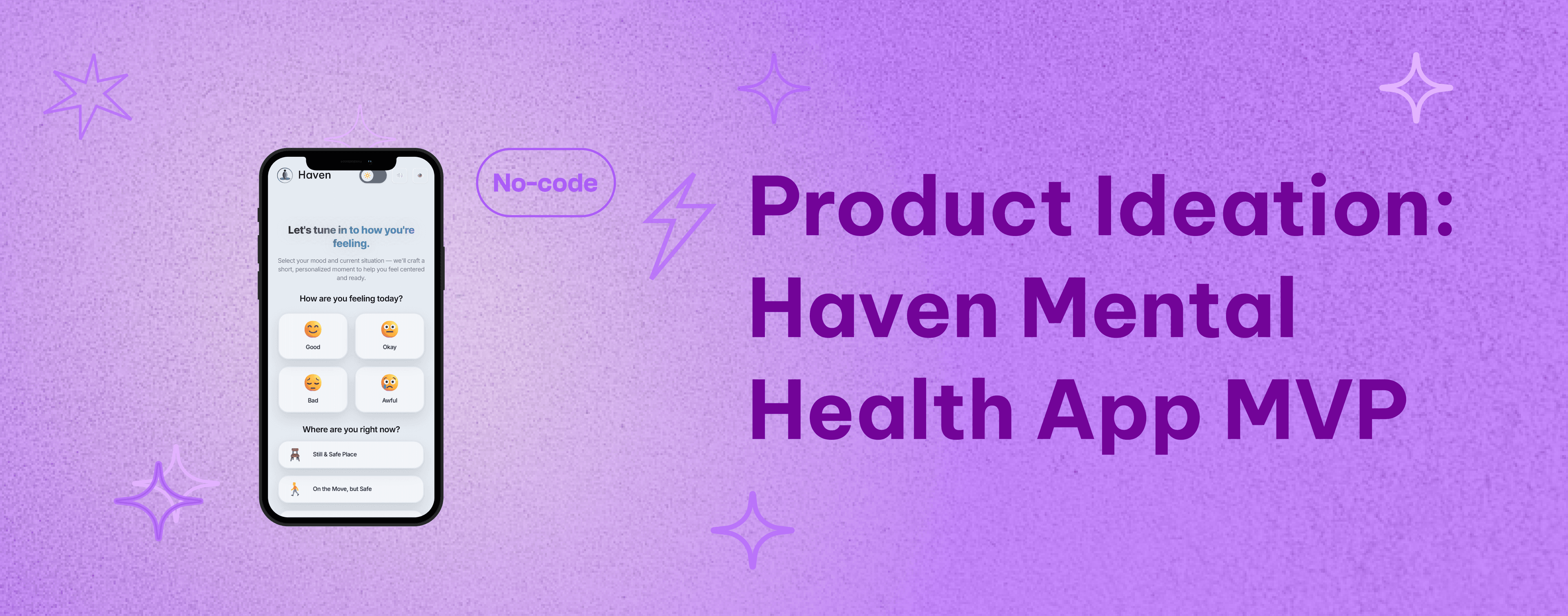
- Core Functionality: Validating the Mood + Context hypothesis. Users could select their current Mood and Context, and receive tailored support in text and audio format.
- Feedback Loop: Gathering qualitative data to refine the final product scope. The MVP served as a live testing ground, collecting valuable user feedback on the relevance and utility of the contextual content.
Outcomes & Refined Product Scope
The no-code MVP was successful in validating the core product idea and providing critical data to finalize the application's scope.
- Hypothesis Validated: The high engagement with the contextual support modules confirmed that personalized, context-aware content is a strong differentiator in the mental health space.
- Refined Final Scope: Based on user feedback from the MVP, I refined the final app scope to include: An expanded range of moods and tailored support types. A 'Personalized Content' track for users to regularly build a meditation habit without needing to define mood/context every time. Integration of progress tracking to visualize growth and improve retention.
Outcomes
- Validated core hypotheses using the no-code MVP, resulting in refined features and a validated scope for the final application
- Confirmed that personalized, context-aware content is a strong differentiator in the mental health space
- Successfully launched a market-ready MVP that served as a live testing ground for product validation
Takeaways
- This project demonstrates my ability to take an ambiguous problem, define a unique product strategy through rigorous research, and rapidly validate the core concept by personally executing a market-ready, no-code MVP.
- Personalized, context-aware content is a strong differentiator in the mental health space
- No-code MVPs can effectively validate product hypotheses before committing to full-scale development